Cleaning and maintaining rooftop solar in UP: what PM Surya Ghar's 5-year maintenance covers, and how to clean panels safely
By BL Solar Solutions · Reviewed by Aditya KumarUpdated · 11 sources
In this article (9 sections)
If your rooftop solar system was installed under PM Surya Ghar, the vendor who installed it must maintain it free of cost for 5 years from commissioning. MNRE's guidelines and model agreement say this covers repairs, replacing parts that fail or under-perform, wear and tear, and regular checks of the system's health. Routine panel cleaning is less clear. MNRE's model agreement asks you to provide the water for cleaning and asks the vendor to teach you how to clean, but it does not say who does the cleaning or how often, so put that in your own agreement. UPNEDA's FAQ says panels need to be cleaned and rinsed with water about every 15 days on average, and that the right interval depends on local conditions. When you clean, use the method in the operation and maintenance (O&M) manual your vendor must give you, work from the walkway rather than the panels, and leave anything electrical to the vendor.
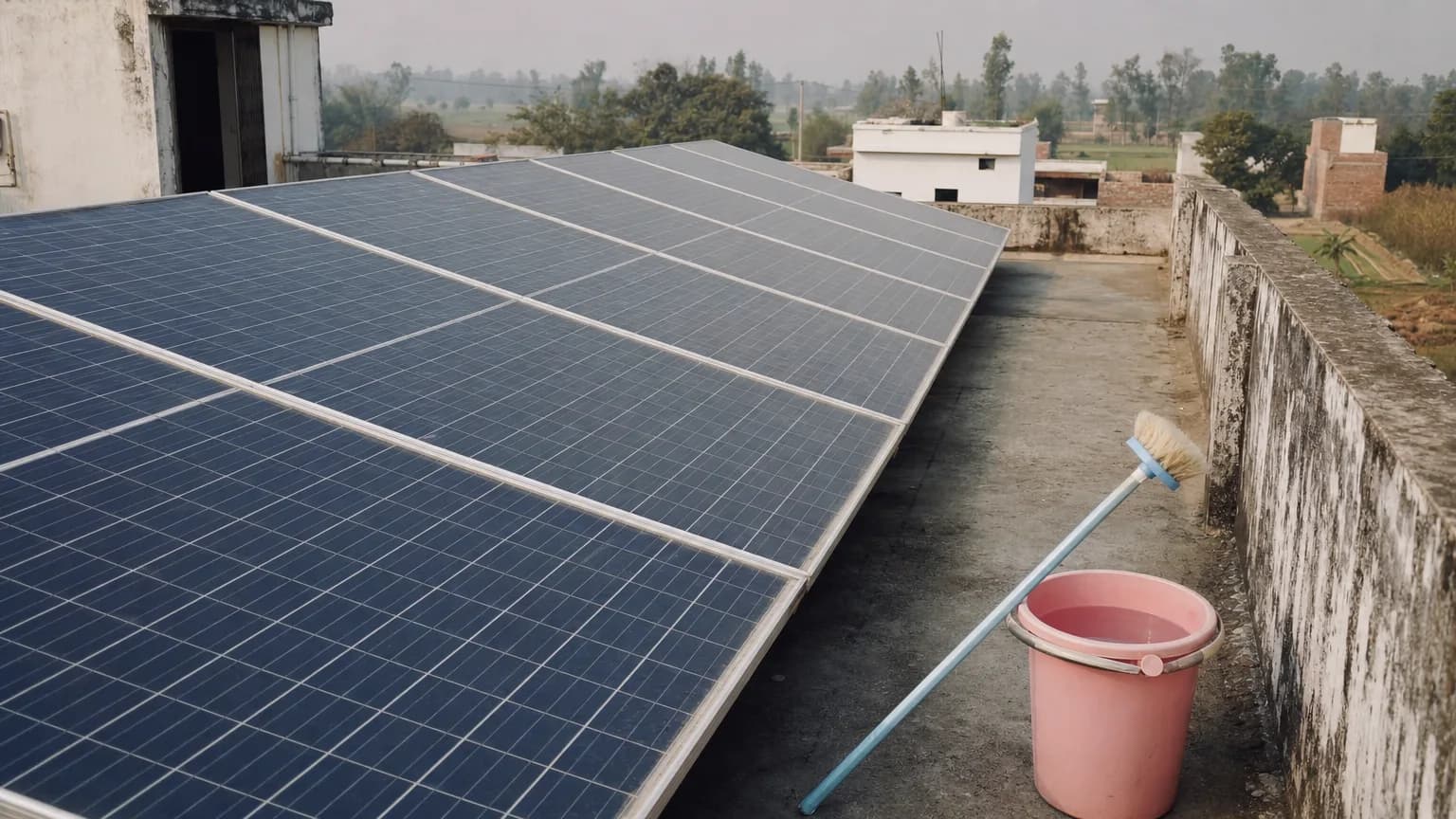
This guide is built from MNRE's PM Surya Ghar guidelines and notices, UPNEDA's rooftop solar FAQ and the Central Electricity Authority's safety regulations. It does not draw on BL Solar's own service records.
What the free 5-year maintenance covers
MNRE's operational guidelines for PM Surya Ghar (consolidated with the amendment of 31 August 2026) set the rule in section 7(d). Registered vendors "shall provide the services to the consumers for repairs/maintenance of the RTS plant free of cost for 5 years of the Comprehensive Maintenance Contract (CMC) period from the date of commissioning". RTS means rooftop solar. The same section says parts that do not work or under-perform "will be replaced/repaired free of cost" during that period.
The model vendor-consumer agreement in Annexure 2 of the guidelines adds detail:
- Operation and maintenance (item 12). "Five (5) years Comprehensive Operation and Maintenance including overhauling, wear and tear and regular checking of healthiness of system at proper interval shall be in the scope of vendor." The vendor must also "educate the consumer on best practices for cleaning of the modules and system maintenance". Modules are the solar panels.
- Warranty (item 9). The complete system must be warranted for 5 years from the date the DISCOM commissions it. The DISCOM is the company that supplies your electricity. The vendor must hand over the manufacturers' warranty documents and help you claim on them.
- Performance (item 18). The performance ratio (PR) must be 75% when the DISCOM commissions the system, and the vendor "must maintain the PR of the plant till warranty of project i.e. 5 years from the date of commissioning". PR compares the electricity a system actually produces with what it should produce from the sunlight that reached it.
Who does what under the model agreement
The agreement has two numbered lists of duties, one for you and one for the vendor.
| Task | Vendor | You |
|---|---|---|
| Repairs, and replacing failed or under-performing parts, for 5 years | Yes, free of cost (guidelines, 7(d)) | |
| Overhauling, wear and tear, and regular health checks "at proper interval" | Yes (Annexure 2, item 12) | |
| Teaching you how to clean the panels | Yes (item 12) | |
| Keeping the performance ratio up for 5 years | Yes (item 18) | |
| Water for cleaning the panels | Yes (your item 4) | |
| Access to the roof for maintenance, testing and meter reading | Yes (your item 3) | |
| Telling the vendor about a fault during the warranty period | Yes (your item 5) |
Three points the model agreement leaves open. Settle them in writing:
- Who cleans the panels, and how often. Delhi's government solar portal reads PM Surya Ghar as making the installing vendor "responsible for cleaning of solar panels" for 5 years. That is Delhi's reading. We did not find a UP document that says the same.
- How often the vendor visits. "At proper interval" is not defined.
- How quickly the vendor responds to a fault. We did not find an official time limit for this.
The guidelines call Annexure 2 a "suggested sample" and say the actual agreement "may vary on a case-to-case basis" (section 6(d)). Under a portal change announced on 23 September 2026, you must review and approve the agreement your vendor uploads, in your own login on the national portal, before installation can go ahead. Read the maintenance clause before you approve it.
Papers your vendor must give you
MNRE's technical specification for the scheme (Annexure 3 of the guidelines) says an O&M manual or user manual, and engineering and electrical drawings, "shall be supplied along with the power plant" (clause 10.1). The manual must include:
- full system details, such as the array layout, a schematic, the inverter details and how the system works (clause 10.2)
- "all the Dos & Don'ts of Power Plant along with Graphical Representation with indication of proper methodology for cleaning, Operation and Maintenance" (clause 10.3)
- step-by-step maintenance and troubleshooting procedures (clause 10.4)
The model agreement adds the warranty cards for the panels and the inverter, the serial numbers, the layout and electrical single-line diagram, and the structure design and drawing (Annexure 2, item 7). A notice to vendors on the portal dated 5 October 2026 tells them to make sure the O&M manual covers the major parts of the system, that the manufacturers' warranty documents show the serial numbers of the panels and inverter actually installed, and that the system warranty covers 5 years from commissioning.
The cleaning method in your manual is the one to follow. If you did not get a manual, ask the vendor for it. For other papers to ask for before you pay, see our guide to avoiding solar fraud.
What the rules say about reaching the panels
Cleaning starts with being able to reach the panels safely. MNRE's technical specification has three clauses on this:
- Clause 3.9. Mounting structures "shall be designed to allow easy replacement, repairing and cleaning of any module".
- Clause 3.10. "Adequate spacing shall be provided between two panel frames and rows of panels to facilitate personnel protection, ease of installation, replacement, cleaning of panels and electrical maintenance."
- Clause 3.12(i)(b). A ballast structure, which is held down by concrete blocks instead of being bolted into the roof, must sit 70 to 150 mm above the roof "to allow ventilation for cooling, also ease of cleaning and maintenance of panels as well as cleaning of terrace".
Junction boxes on the structure must also be "easily accessible" (clause 5.5). A junction box is the sealed box where panel cables are joined.
The Central Electricity Authority (CEA) sets national electrical safety rules. Its 2023 safety regulations, which replaced the 2010 ones, include a regulation on solar installations (regulation 121). It asks for:
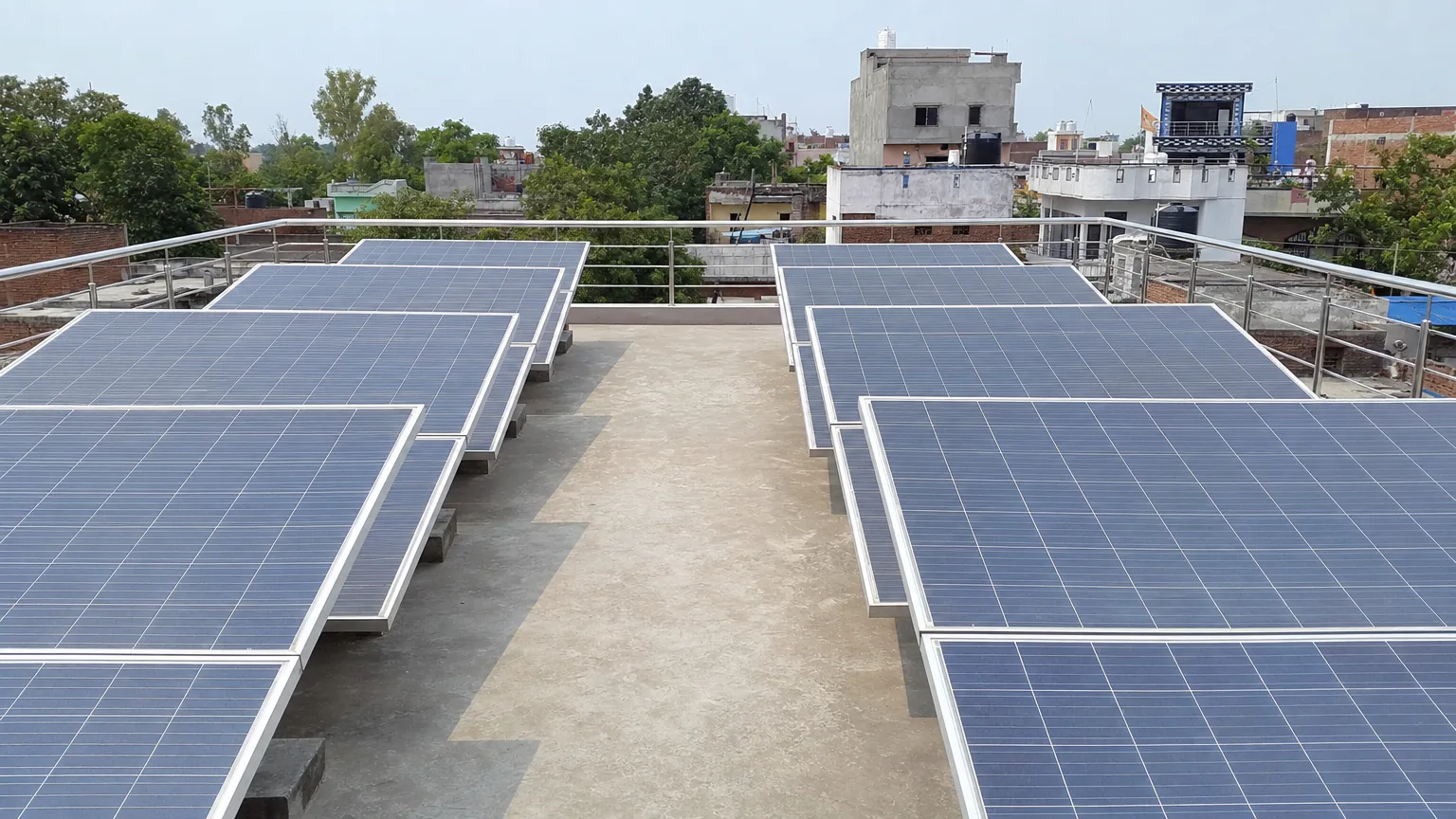
- "clear pathways of minimum seventy five centimetre in width with hand rails for roof access and emergency exit" for rooftop systems
- "clear pathways, walkways between the rows or columns of solar panels which is necessary for cleaning and maintenance"
- switches or circuit breakers that disconnect the panels at "a readily accessible location", and a manual switch to isolate the system from the grid
MNRE's specification separately requires the system to follow the electrical safety rules under the Electricity Act, 2003 and the CEA's safety regulations (clause 11.2).
Neither document asks for a water tap on the roof, and the model agreement makes water for cleaning your job. If there is no tap near the panels, agree with the vendor before installation how water will reach them. Our mounting structure guide explains the structure types and heights in MNRE's specification.
Representative image
How often solar panel cleaning is needed
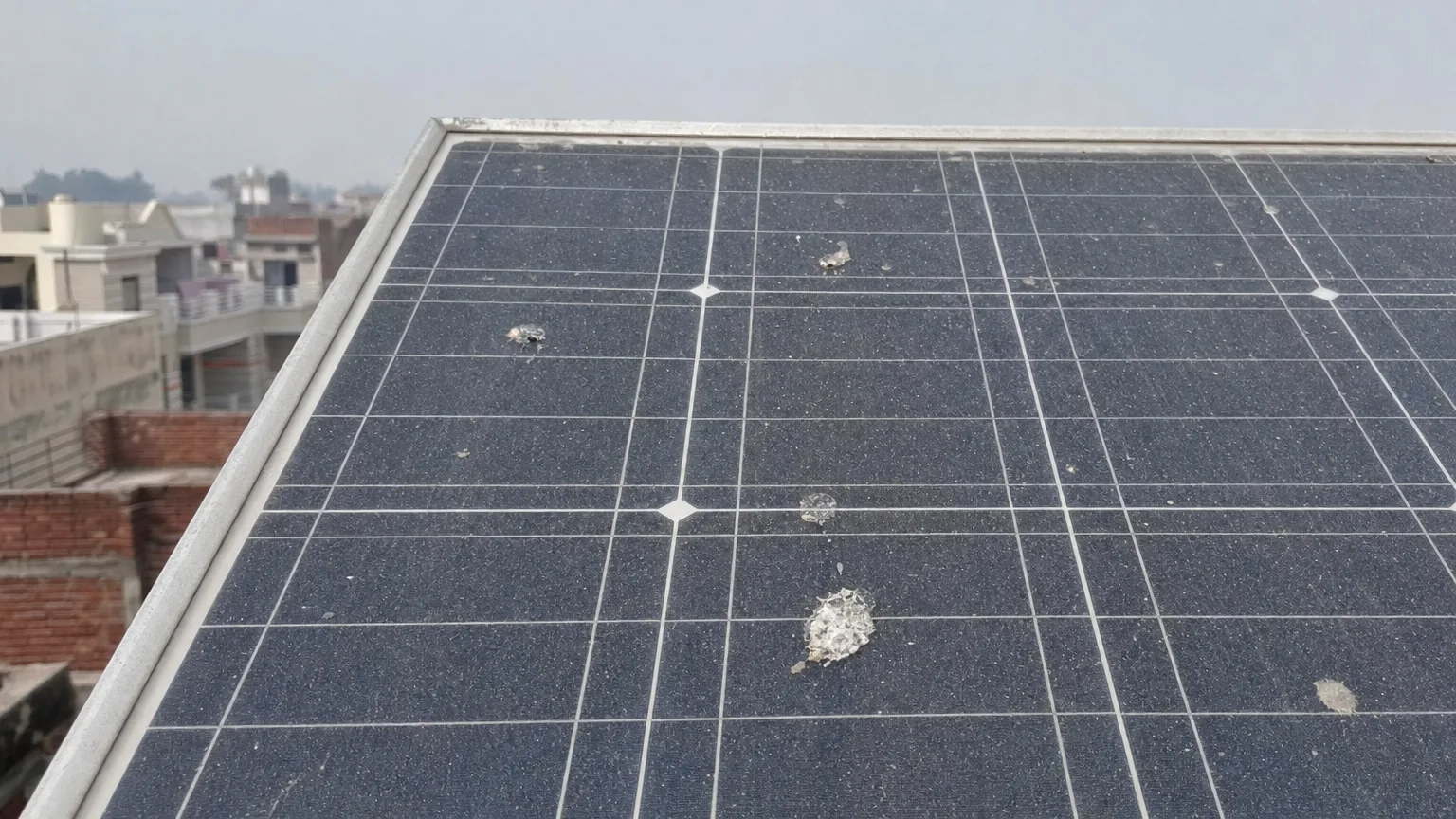
UPNEDA's rooftop solar FAQ answers this directly: "Module cleaning is a typical maintenance activity that is required periodically (dust, bird dropping, and other debris can cause a decrease in power generation). The frequency of cleaning is dependent on local conditions. On an average, the module needs to be cleaned and rinsed with water at an interval of 15 days."
So 15 days is an average, not a fixed rule. An older MNRE FAQ for rooftop consumers says the interval "depends on local conditions like dust, birds, air pollution, etc." The European Commission's Joint Research Centre (JRC), which runs the PVGIS solar model, notes that "in areas with a lot of dust in the air the modules will tend to be covered in dust", and that how long the dust stays "depends on rainfall and on the inclination of the modules". Inclination means tilt. Our solar panel tilt angle calculator shows the usual tilt for your city.
Representative image
Let the units tell you
Your inverter must be able to send system data through a SIM card or dongle (Annexure 3, clause 2.7(xiv)). In August 2026, MNRE told inverter makers to send each system's daily generation to the national portal. Note your units from the inverter's display or app. If output stays low on clear days even after a clean, call the vendor. Keeping the performance ratio up for 5 years is in the vendor's scope.
How to clean safely
We did not find an official Indian guideline that sets the brush, the water quality or the time of day for cleaning a home system. Those depend on the panel manufacturer's manual and on the O&M manual your vendor gives you. What the official documents do support:
- Use the cleaning method in your O&M manual. MNRE's specification requires the manual to show the proper cleaning method with drawings (clause 10.3), and says vendors should educate consumers (clause 10.5).
- Switch off and follow the manual. Before you start, switch the system off the way your manual or your vendor shows you, and follow the manual's steps.
- Clean from the walkway and the gaps between rows. The CEA's walkway rule and MNRE's spacing clause expect cleaning to be done from there, not from on top of the panels or the frame.
- Leave the electrical parts alone. Do not open or adjust the inverter, junction boxes, cables or connectors. The CEA's safety regulations say no one should operate or carry out maintenance on electrical apparatus unless designated for that work and following set safety precautions (regulation 21(3)). Electrical checks are part of the vendor's 5-year maintenance.
- Clean gently. MNRE's May 2026 warranty procedure for solar panels lets a manufacturer refuse a claim for "misuse, neglect, tampering, or improper handling", and for glass breakage caused by verified external or man-made damage. Cleaning the way the manual says is the safest way to avoid an argument over these exclusions.
- If the panels are high or hard to reach, ask the vendor. Teaching you a safe method is in their scope, and so is the 5-year maintenance.
A note on monkeys, a common question in UP. UPNEDA's FAQ says panel tops are made of toughened or tempered glass and are "not easily broken due to monkeys or any falling objects like hail". It does not recommend covering panels with wire mesh, because the mesh casts a shadow on them.
What to look at between visits
The guidelines require independent third-party inspection of at least 1% of systems installed under the scheme (section 10(b)), and the portal picks them at random. The portal's manual for fixing the defects they find lists what they look at. It is also a useful list for you. Look from the walkway and do not touch anything:
| What inspectors check | What you might notice |
|---|---|
| Panels fixed properly to the structure | A panel that is loose |
| "Snail trails", discolouration, breakage or deformation of panels | Cracked glass, or dark or brown marks on the cells under the glass |
| A delaminated or loose junction box on a panel | Layers peeling apart, or a box hanging loose at the back of a panel |
| Inverter checks, including DC input, AC output, cumulative generation and the grid availability indicator | A blank display, an error message, or a generation total that stops rising |
| DC and AC distribution boxes provided | These switch boxes are in place |
| Earthing provided and connected; lightning protection provided | Earthing wires attached, and a lightning arrester in place |
| Condition of the structure | Rust, bent parts or loose bolts |
| O&M manual and warranty documents provided | You have them |
If inspectors find defects, the vendor has 15 days to fix them and upload proof. After that the portal issues a show-cause notice, and a vendor who leaves a defect unfixed for 30 days is deactivated on the portal for a month.
An older MNRE FAQ for rooftop consumers lists the kind of checks routine maintenance includes: module connections, junction boxes, the mechanical soundness of the structure, tightening loose cable connections, replacing blown fuses, and repairing lightning damage or damage caused by intruders or during cleaning.
If you notice a problem, report it to the vendor. The model agreement makes that your job during the warranty period (your item 5).
If the vendor does not respond
- Report the fault to the vendor first, and keep a record of when you did.
- Raise a grievance on the national portal. The guidelines say consumers can raise grievances through the national portal, the portal app or the national call centre, and get a tracking ID. Grievances "will be resolved within a period of 30 days" (section 11). The portal lists the toll-free number 15555. UPNEDA's FAQ also points consumers to the grievance section of the national portal.
- Know the limits. The model agreement says disputes between you and the vendor must be settled between you or as per law, and that MNRE and the DISCOM are not a party to them (Annexure 2, item 16).
For a faulty panel, the manufacturer's warranty applies as well as the vendor's. MNRE's procedure of 6 May 2026 for panels installed under its schemes sets out what manufacturers must offer:
| Point | What MNRE's procedure says |
|---|---|
| Product warranty | At least 10 years against defects in design, materials, workmanship or manufacturing |
| Power output warranty | 25 years |
| When it starts | From installation or commissioning, if the panel is installed within six months of its sale invoice; otherwise the period is reduced |
| Complaint channel | A helpline and an online portal where you can download a warranty certificate for each panel |
| Acknowledgement | Within 24 to 48 hours |
| Repair or replacement | Within 30 days, or 90 days if new panels have to be made |
The scheme's technical specification, written earlier, asks for at least 5 years against panel defects (Annexure 3, clause 1.10). MNRE's procedure also says DISCOMs and implementing agencies are not a party to warranty claims. For inverters, MNRE's August 2026 instruction asks inverter makers to include the data logger in the inverter warranty.
After the first 5 years
MNRE's guidelines provide free maintenance for 5 years. We found nothing in them about maintenance after that, and no official price for it. Any later contract is between you and a vendor, on terms you agree. The panels' 25-year power output warranty from the manufacturer continues.
Planning a new system?
If you are planning rooftop solar and want the panels laid out so they can be reached for cleaning, send a photo of your roof and your latest electricity bill on WhatsApp to +91 92609 40733. We will arrange a site survey.
Related guides:
Sources
- MNRE, Operational Guidelines for PM Surya Ghar, CFA to Residential Consumers (7 June 2024, amended to 31 August 2026): sections 6(d), 7(d), 8(a)(ix), 10(b) and 11; Annexure 2 (model agreement); Annexure 3 (technical specifications)pmsuryaghar.gov.in · Accessed 21 November 2026
- Ministry of New and Renewable Energy, Office Memorandum of 6 May 2026, "Standard Operating Procedure (SOP) for Warranty Management of Solar PV Modules installed under Distributed Renewable Energy Schemes of the MNRE", What's Newpmsuryaghar.gov.in · Accessed 21 November 2026
- Ministry of New and Renewable Energy, Office Memorandum of 17 August 2026 on inverter-level generation data, What's New ("OM - Inverter Level Generation Data")pmsuryaghar.gov.in · Accessed 21 November 2026
- PM Surya Ghar National Portal, notices to vendors "Consumer Verification of Agreement Upload" (23 September 2026) and "Do's and Don'ts in Submission of Defect Rectification Proofs via Vendor Login" (5 October 2026), What's Newpmsuryaghar.gov.in · Accessed 21 November 2026
- PM Surya Ghar National Portal, "User Manual for FQI Defect Module in Vendor Login" (defects checked in third-party field quality inspections, and the 15-day and 30-day rules)pmsuryaghar.gov.in · Accessed 21 November 2026
- PM Surya Ghar National Portal, home page (toll-free number 15555)pmsuryaghar.gov.in · Accessed 21 November 2026
- UPNEDA, "FAQs related to rooftop solar", questions 5.6, 6.2 and 6.3upneda.org.in · Accessed 21 November 2026
- Ministry of New and Renewable Energy, "FAQ: Grid Connected Solar Rooftop System", question 6.2 (from the earlier rooftop programme; copy hosted by Jharkhand Bijli Vitran Nigam Limited)jbvnl.co.in · Accessed 21 November 2026
- Central Electricity Authority (Measures relating to Safety and Electric Supply) Regulations, 2023, regulations 21(3) and 121(1)cea.nic.in · Accessed 21 November 2026
- European Commission, Joint Research Centre, "PVGIS data sources & calculation methods", section 5.2.6 (dust and dirt)joint-research-centre.ec.europa.eu · Accessed 21 November 2026
- Delhi Solar Portal, "Operation and maintenance procedure"solar.delhi.gov.in · Accessed 21 November 2026
Related guides

BL Solar Solutions
Editorial Team
Published by BL Solar Solutions, a UPNEDA registered rooftop solar installer with 10+ years of experience in Uttar Pradesh.
Comments (0)
Share your thoughts and join the conversation
No comments yet
Be the first to share your thoughts!