Power cuts and solar in UP: what an on-grid system does in an outage, and when a hybrid makes sense
By BL Solar Solutions · Reviewed by Aditya KumarUpdated · 8 sources
In this article (7 sections)
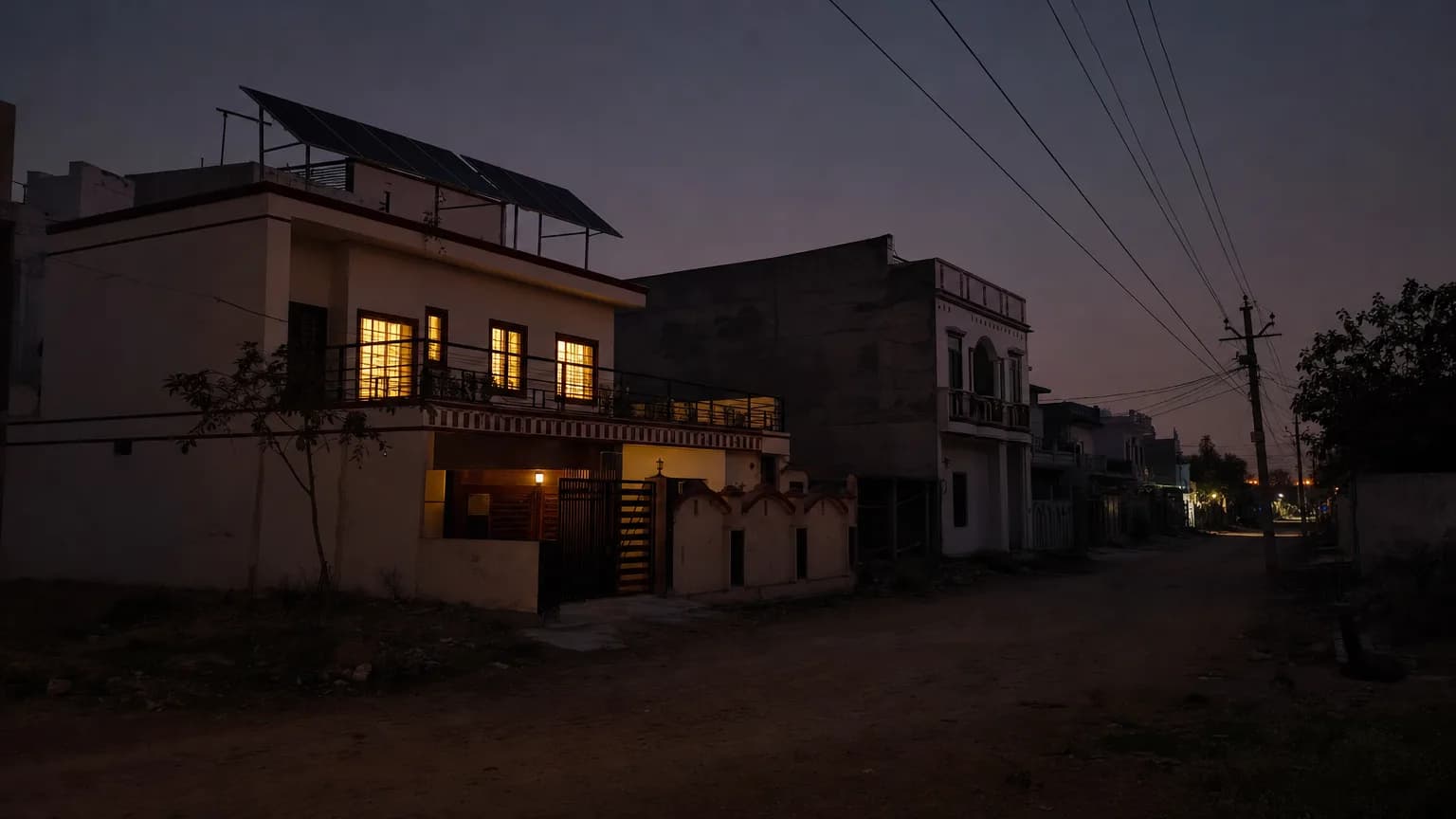
A normal on-grid rooftop solar system gives you no power during power cuts, even at noon. Safety rules make its inverter switch off within two seconds of the grid failing, so it cannot push electricity into lines that a lineman expects to be dead. UPNEDA's rooftop solar FAQ says it plainly: the system "will not supply power during the power cut". For solar to keep lights and fans running in a cut, the system needs a battery. A grid-connected system with a battery is called a hybrid system. Its hybrid inverter also cuts itself off from the grid, and then runs only the circuits wired to its backup output. Under PM Surya Ghar, MNRE's guidelines allow battery storage as an extra part of the system, but the subsidy is still worked out only on the solar panels' capacity. The battery adds to your cost, not to your subsidy.
What an on-grid system does when the grid fails
An on-grid system (also called grid-tied or grid-connected) works alongside the supply from your DISCOM, the company that delivers your electricity. It has no battery. UPNEDA's FAQ for home rooftop systems answers both points directly:
- "There is no battery provided with the grid-connected rooftop solar system."
- "The grid-connected RTS system, will not supply power during the power cut. The system requires a reference voltage from the grid to operate which will not be available during power cuts."
So on a sunny afternoon with no grid supply, the panels sit on the roof and the inverter stays off. Three sets of rules require this:
- Central Electricity Authority (CEA). Its connectivity regulations for generators connected to the grid below 33 kV, which cover home rooftop systems, require a function that stops the system from forming an "unintended island" and makes it "cease to energise the electricity system within two seconds". The same rule says the system must not reconnect until the grid's voltage and frequency are within limits and "stable for at least sixty seconds". That is why solar output takes at least a minute to come back after the power returns.
- MNRE's technical specifications for PM Surya Ghar. Annexure 3 of the scheme guidelines says the rooftop system "shall be equipped with islanding protection". Its list of standards includes IEC 62116 / IS 16169, the "test procedure of islanding prevention measures" for grid-connected solar inverters, which checks that an inverter stops feeding a grid that has gone dead.
- UP's net metering rules. In the net metering agreement attached to UPERC's 2019 rooftop solar regulations, the consumer agrees that "in case of a power outage on Licensee's system, photovoltaic system will disconnect/isolate automatically and his plant will not inject power" into the DISCOM's network. The consumer also agrees to install an isolation device, both automatic inside the inverter and manual.
Why this protects linemen
An "island" is a piece of the grid that stays live because a generator, here a rooftop inverter, keeps feeding it after the main supply has gone. In a power cut, linemen may work on that line believing it is dead. If the inverters on that street kept running, it would not be.
MNRE's specification puts it this way: powered islands "present a risk to workers who may expect the area to be unpowered, and they may also damage grid-tied equipment". MNRE's model net metering agreement adds that the DISCOM is not responsible for any accident caused by back-feeding from a rooftop system "when the grid supply is off". Switching off in an outage is what the system is meant to do. It is not a fault.
Representative image
What a hybrid solar system does differently in power cuts
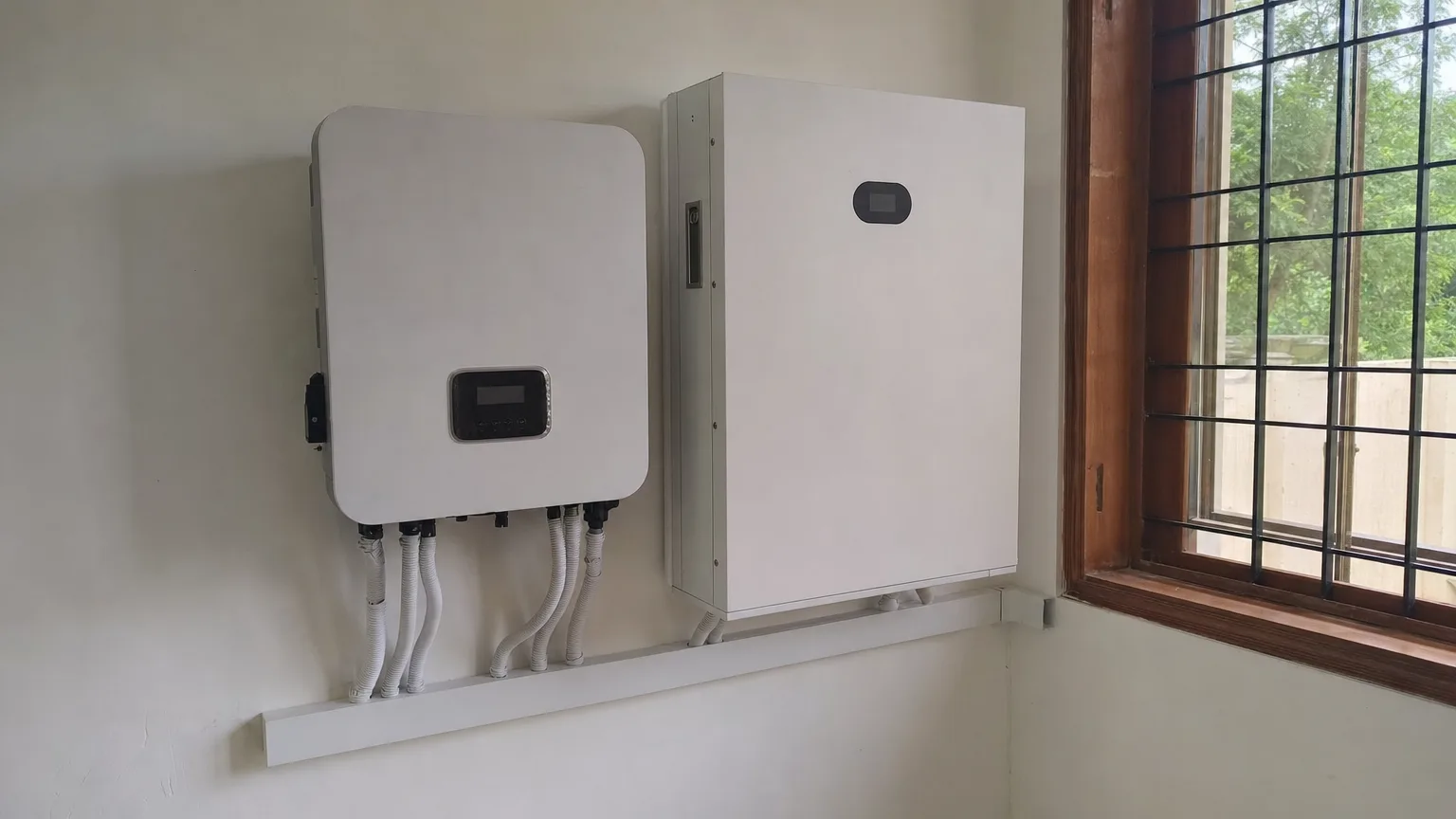
A hybrid system is a grid-connected rooftop system with a battery. Its hybrid inverter works with the grid on normal days, and can also charge the battery and draw on it.
In a power cut, the same safety rules apply to it. CEA's 2019 amendment brings a "prosumer", which it defines to include an energy storage system, under these connectivity regulations, and applies the generator standards to a prosumer "when acting as a generator". So a hybrid inverter must cut itself off from the grid first. Only then can it run the circuits wired to its backup output, from the battery and, when the sun is up, from the panels.
UP's regulations do not spell out how the backup wiring must be done. Some states do. MNRE's February 2026 summary of state rules quotes Bihar's, which allow a grid-connected system "with or without battery backup". If a battery is used, the inverter must have separate backup wiring so that battery or solar power cannot flow into the grid when grid supply is absent, and a manual isolation switch must be fitted. That is Bihar's rule, not UP's, but it is a fair question to ask any installer in UP: which circuits go on backup, and how is the system isolated from the grid?
PM Surya Ghar subsidy with a battery or hybrid inverter
MNRE's operational guidelines for the scheme (consolidated with the amendment of 31 August 2026) answer most of this.
- A battery is allowed, but adds nothing to the subsidy. Section 5(l): "The rooftop solar installation may include additional technology components such as small wind hybrids, battery storage, solar tracker systems etc. However, the CFA calculation shall be based on the CFA structure under the scheme as per capacity of solar modules installed in the system." CFA (central financial assistance) is the central subsidy.
- The inverter's size does not change the subsidy. Section 5(k) says the subsidy is worked out on the panels' rated DC capacity, not the inverter's. The inverter, hybrid or not, must still meet the scheme's technical specification, which includes the islanding protection and IS 16169 testing described above.
- The panels must still be DCR. Section 5(m): panels must be made in India from cells made in India for the system to get the subsidy.
- Systems that do not send power to the grid. Section 6(o) says grid-connected systems that do not feed into the grid, including "battery hybrid systems", "shall be eligible for CFA under the scheme subject to approval by the respective Electricity Regulatory Commissions". The DISCOM then checks the reverse power relay, a protection device that stops power flowing out to the grid. We did not find a UPERC provision for such systems in UP.
- Off-grid systems get no subsidy. The same section says off-grid installations "will not be eligible for CFA under the scheme". Off-grid means a system with no connection to the DISCOM's supply.
The national portal's FAQ says the maximum subsidy for a home under the scheme is Rs 78,000. Its 18 questions do not mention batteries or hybrid inverters.
UP's own subsidy has a condition worth noting. The UP Solar Energy Policy 2022 gives Rs 15,000 per kW, up to Rs 30,000 per consumer, for grid-connected rooftop systems "under Net-Metering arrangement", paid after the system is commissioned with net metering. A hybrid system that stays on net metering fits that wording. One that does not export under net metering would not.
UPNEDA's FAQ, answering what warranty the scheme expects, lists "storage batteries" among the parts that must be warranted for at least 5 years against manufacturing, design or installation defects.
Does net metering still work with a hybrid?
No UP document we found says yes or no in so many words. Here is what the documents do say:
- UPERC's rooftop solar regulations of 2019, and their amendments of 2022, 2023 and 2025, say nothing about batteries or hybrid inverters, either to allow or to forbid them. They do require the system to isolate itself from the grid in an outage.
- MNRE's guidelines allow battery storage as part of a subsidised system (section 5(l)), and say that all metering arrangements approved by a state's electricity regulatory commission, net metering included, are covered by the scheme (section 6(l)).
- MNRE's February 2026 summary of state rules lists no battery condition for UP.
So nothing in these rules bars a battery on a net-metered home in UP, but nothing confirms it in writing either. Before you buy, ask the vendor to confirm with your DISCOM that the hybrid inverter will be accepted for net metering, and to put that in writing.
When a hybrid makes sense: a worked estimate
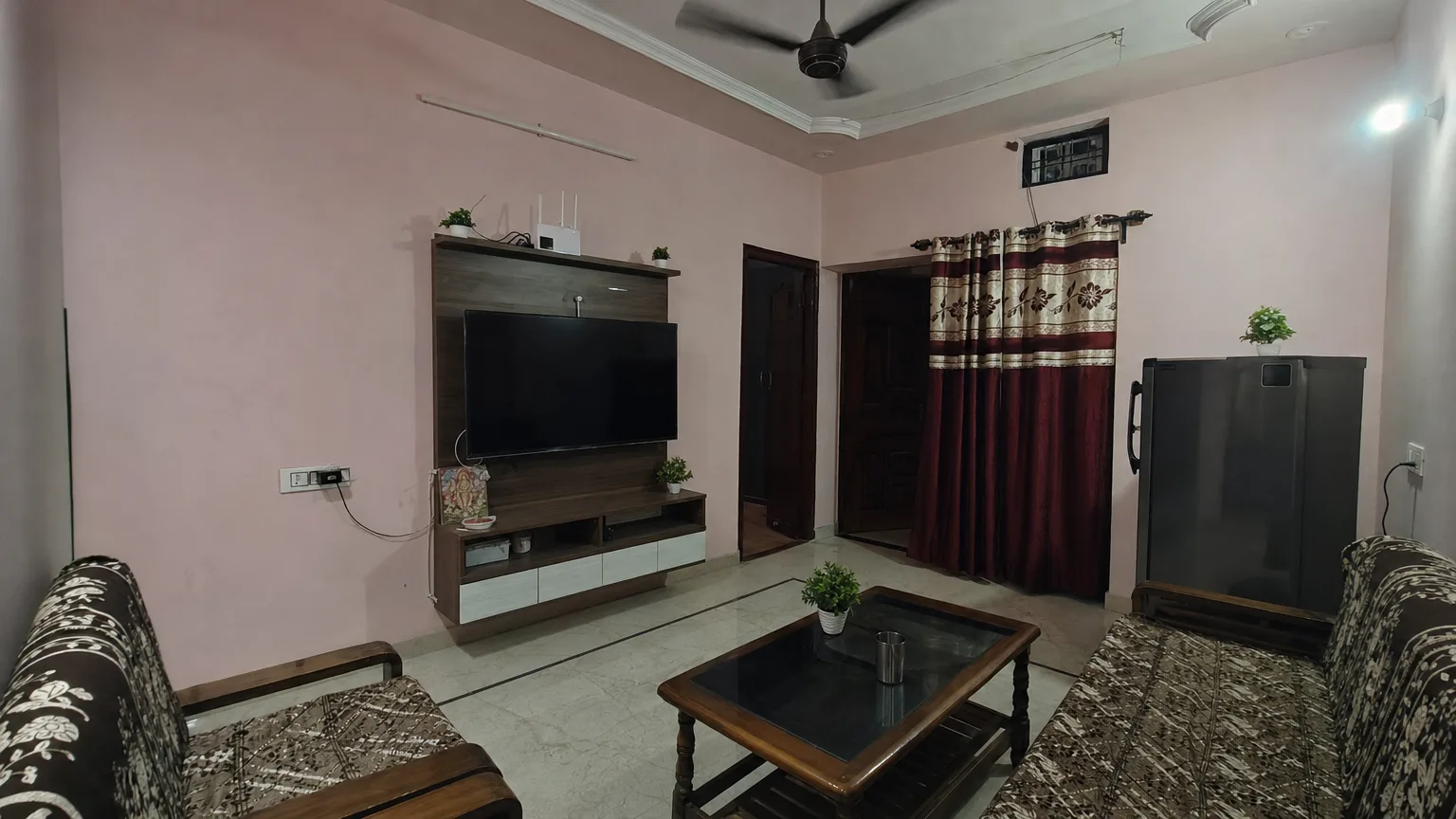
There is no official figure for how much backup a UP home needs. The practical way to decide is to list what you must run during a cut, and add up the energy. The example below uses assumed wattages and hours for a sample home. It is an estimate, not a measurement. Put in the wattage from your own appliance labels and your own pattern of cuts.
Step 1. Essential loads for a 4-hour evening cut (watts × hours = watt-hours, Wh)
| Appliance | Number | Watts each (assumed) | Hours (assumed) | Wh |
|---|---|---|---|---|
| LED bulb | 4 | 10 | 4 | 160 |
| Ceiling fan | 3 | 75 | 4 | 900 |
| Wi-Fi router | 1 | 10 | 4 | 40 |
| Fridge (average draw) | 1 | 60 | 4 | 240 |
| LED TV | 1 | 100 | 2 | 200 |
| Phone charger | 2 | 10 | 2 | 40 |
| Total | 1,580 Wh |
A fridge's compressor switches on and off, so this example assumes an average of 60 W rather than its full rating.
Step 2. Usable battery energy. Batteries are not meant to be emptied fully. Depth of discharge (DoD) is the share of the rated energy you are meant to use before recharging. The battery's datasheet gives it. Some energy is also lost in the inverter.
- Usable battery energy = rated capacity × DoD
- Energy that reaches your appliances = usable battery energy × inverter efficiency
This example assumes a DoD of 80% and an inverter efficiency of 90%.
Step 3. Battery size for this list. Rated capacity needed = 1,580 Wh ÷ (0.8 × 0.9) = about 2,194 Wh, or about 2.2 kWh.
Batteries are often rated in amp-hours (Ah). Multiply by the battery's voltage and divide by 1,000 to get kWh. For example, 100 Ah at 24 V is 2.4 kWh. At the same assumptions, that gives 2.4 × 0.8 × 0.9 = about 1.73 kWh at the appliances, which covers the 1,580 Wh above. Our solar backup hours calculator works the other way round: enter a battery's Ah, voltage and type, and your running load in watts, to see how many hours it lasts. For this list, 1,580 Wh over 4 hours is an average of about 395 W. The calculator uses its own depth of discharge for each battery type, so its answer will differ a little from this example.
Representative image
What the example shows:
- Fans are more than half the energy in this list. Each fan you put on backup adds noticeably to the battery you need.
- Hours matter as much as appliances. If the same cut lasted 8 hours, with the TV and charging unchanged, the need rises to 2,920 Wh and the battery to about 4.1 kWh.
- Back up only what you must. A hybrid does not have to run the whole house. High-wattage appliances, such as an air conditioner, a water pump or a geyser, raise the total quickly. Put their label wattage into the same table before you decide to include them.
- Check the inverter's backup power rating too. The backup output has a limit on how many watts it can supply at once. Ask the installer to check it against everything on your list that may run together, including the fridge starting up.
On-grid or hybrid: how to decide
An on-grid system alone may be enough if:
- power cuts in your area are rare or short, or come at times you can manage without power, and
- your main aim is a lower electricity bill with the subsidy.
A hybrid is worth pricing if:
- you have regular cuts at times you need power, especially after dark, when the panels produce nothing and everything comes from the battery,
- your essential load list gives a battery size you are willing to pay for, knowing the subsidy does not cover it, and
- your DISCOM confirms net metering with the hybrid inverter.
If you want the subsidy, do not choose an off-grid-only system. MNRE's guidelines exclude it.
What changes the cost of a hybrid system
This guide gives no hybrid price. The cost figures in MNRE's scheme guidelines and UPNEDA's rooftop FAQ are for grid-connected systems, and neither gives a figure for a battery or a hybrid inverter. MNRE's guidelines say the ministry will publish indicative costs of system components. We did not find such a list in the portal's What's New section on 21 November 2026.
What moves the cost, compared with an on-grid system of the same panel capacity:
- Battery energy (kWh). This is set by your essential load list and how long your cuts last, as in the example above.
- Depth of discharge. A battery you can use more deeply needs less rated capacity for the same backup.
- The hybrid inverter's backup power rating. More appliances running at once need a larger backup output.
- Backup wiring and switches. A separate circuit for essential loads and the isolation switch add work and material.
- Warranty terms. UPNEDA's FAQ expects at least 5 years against defects for parts including storage batteries. Check what the quote actually offers.
- Panel capacity. This is the part the subsidy covers. Our solar panel price guide shows the official cost range for on-grid systems.
Ask for the panels, the hybrid inverter, the battery and the backup wiring as separate lines on the quote. Then you can see what the subsidy covers and what it does not. For the subsidy steps themselves, see how to apply for PM Surya Ghar.
Get advice for your home
If you are weighing an on-grid system against a hybrid, send a photo of your roof, your latest electricity bill and the list of appliances you want to run during power cuts on WhatsApp to +91 92609 40733. We will arrange a site survey and go through both options with you.
Related guides:
Sources
- MNRE, Operational Guidelines for PM Surya Ghar, CFA to Residential Consumers (7 June 2024, amended to 31 August 2026): sections 5(k) to 5(m), 6(l) and 6(o); Annexure 3, clauses 2.1, 2.2 and 2.11; Annexure 4, clauses 2.2 and 3.5pmsuryaghar.gov.in · Accessed 21 November 2026
- PM Surya Ghar: Muft Bijli Yojana National Portal, Frequently Asked Questions, question 14 (maximum subsidy)pmsuryaghar.gov.in · Accessed 21 November 2026
- Ministry of New and Renewable Energy, "Rooftop Solar Regulations of States / UTs as on February 2026" (rows for Uttar Pradesh and Bihar), posted 12 March 2026 under What's Newpmsuryaghar.gov.in · Accessed 21 November 2026
- Central Electricity Authority (Technical Standards for Connectivity of the Distributed Generation Resources) Regulations, 2013, regulations 2(1)(m), 11(6)(d) and 11(6)(e)cea.nic.in · Accessed 21 November 2026
- Central Electricity Authority (Technical Standards for Connectivity of the Distributed Generation Resources) Amendment Regulations, 2019 (prosumer definition and regulation 11), same pagecea.nic.in · Accessed 21 November 2026
- Uttar Pradesh Electricity Regulatory Commission, UPERC (Rooftop Solar PV Grid Interactive System Gross / Net Metering) Regulations, 2019, Annexure II and Annexure III(B) clauses 2.2 and 2.3, with the amendments of 2022, 2023 and 2025uperc.org · Accessed 21 November 2026
- UPNEDA, "FAQs related to rooftop solar", questions 1.3, 1.4 and 6.1upneda.org.in · Accessed 21 November 2026
- Government of Uttar Pradesh, Uttar Pradesh Solar Energy Policy 2022, section 7.3(a) (hosted by UPNEDA)upneda.org.in · Accessed 21 November 2026
Related guides

BL Solar Solutions
Editorial Team
Published by BL Solar Solutions, a UPNEDA registered rooftop solar installer with 10+ years of experience in Uttar Pradesh.
Comments (0)
Share your thoughts and join the conversation
No comments yet
Be the first to share your thoughts!