"Free electricity" under PM Surya Ghar: why a UP solar home still gets a bill, and what is on it
By BL Solar Solutions · Reviewed by Aditya KumarUpdated · 11 sources
In this article (8 sections)
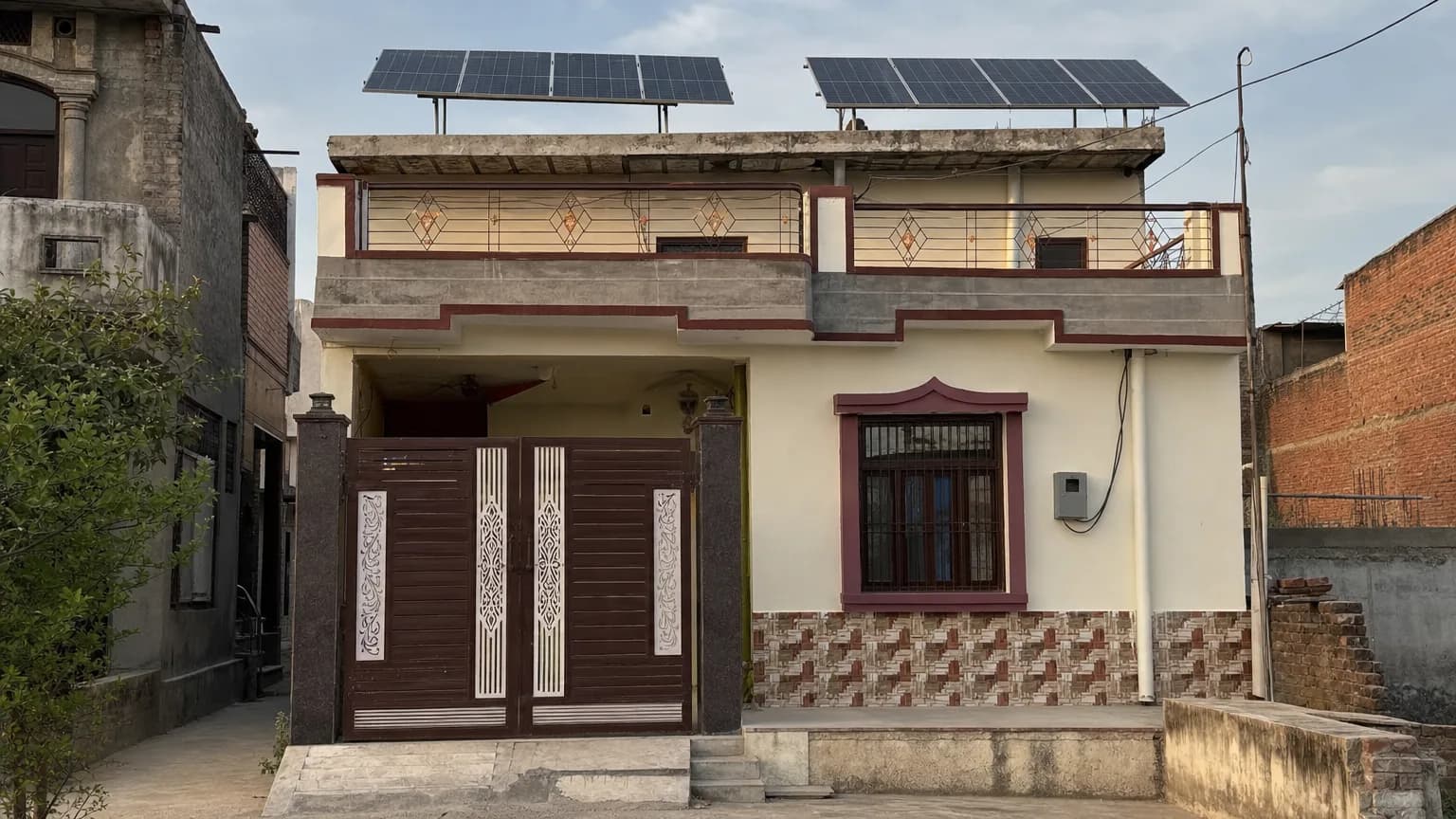
The "free electricity" (muft bijli) in PM Surya Ghar means the power your own rooftop panels make, described by the government as "up to 300 units" a month. No official document says your electricity bill will become zero. UPPCL says plainly that solar can lower your bill but will not make it fully zero, because the fixed charge, electricity duty and other applicable charges are due every month. In a month when you export more than you import, only the energy charge is zero, and the leftover units carry forward to the next month. Units still left at the end of March are paid for at Rs 2 per unit. On a domestic connection outside the rural schedule, the fixed charge is Rs 110 per kW a month, so Rs 330 on a 3 kW load, with or without solar.
What the official documents actually say about "300 units free"
| Source | Its own words |
|---|---|
| Cabinet approval, PIB, 29 February 2024 | "providing free electricity up to 300 units every month for One Crore households" |
| PM Surya Ghar National Portal, home page | "aims to light up 1 crore households by providing up to 300 units of free electricity every month" |
| MNRE scheme guidelines, section 3(b) | "To help provide free/low-cost electricity to 1 crore households up to 300 units of electricity per month by installation of rooftop solar" |
| PIB, same release, further down | "A 3 kW system will be able to generate more than 300 units a month on an average for a household." |
Three things follow from these words:
- "Up to" is a ceiling. 300 units is not a fixed quota that every home gets every month. The PIB release's sub-headline ("Households to get 300 units of electricity free every month") leaves out "up to", but its main text includes it.
- Your own panels make this electricity. The DISCOM does not give you 300 free units. Whatever your system generates and your home uses is electricity you do not take from the grid. The portal's own guide suggests 1 to 2 kW for a monthly use of 0 to 150 units, 2 to 3 kW for 150 to 300 units, and above 3 kW for more than 300 units.
- MNRE says "free/low-cost". The scheme's own guidelines accept that electricity will not be fully free for every home.
Why a solar home's bill is not zero, even with muft bijli
UPPCL's smart postpaid meter FAQ, dated 27 May 2026 and published in Hindi, asks this exact question at number 33: "Will the electricity bill end completely after installing solar?" Its answer begins "No." and goes on (our translation):
"So installing solar can reduce your bill, but it will not be fully zero, because some essential charges always have to be paid."
According to UPPCL, when your export is more than your import in a month, only the energy charge is zero. You still pay the fixed charge, electricity duty and other applicable charges, and if you do not pay them on time your connection can be cut.
Two more official sources say the same:
- UPNEDA's rooftop solar FAQ (question 2.8) asks whether solar can make the monthly bill "zero". It answers that this "is possible in very rare cases because the consumer shall be required to pay some minimum charges like fixed charges, etc. even if the consumed energy is all self-generated."
- The UP Electricity Regulatory Commission (UPERC) Rooftop Solar Regulations 2019, regulation 10.4, say that regardless of any electricity credits, "the consumer shall continue to pay applicable charges such as fixed/ demand charges, Government levy etc." The same regulation says excess units "may only be utilized to offset the consumption measured in kilo-watt hour and may not be utilized to compensate any other fee and charges".
Which bill lines solar changes
| Bill line | What it is | Does solar change it? |
|---|---|---|
| Fixed charge | A monthly charge on your connection's load in kW | No |
| Energy charge | Charged on net units: import minus export minus any units carried forward | Yes. Zero in a month when export is higher |
| Electricity duty | A state government duty whose rate the state sets by notification | UPERC's rule says government levies stay payable. We could not find today's domestic rate in an official source, so read it on your bill |
| FPPAS (fuel and power purchase adjustment surcharge) | Passes changes in the cost of buying power on to bills. UPERC's order says the DISCOM shows it separately on the bill | It can change every month |
Two payment rules also affect what you pay. Under UPERC's 2026-27 rate schedule:
- Paying by the due date earns a 1% rebate on the fixed and energy charges, as long as there are no arrears.
- After the due date, a surcharge of 1.25% a month applies to the dues for the first three months, then 2% a month.
Representative image
How units are counted each month and at year end
Under UPERC regulation 10.4 and UPPCL's FAQ (question 33):
- Each month the meter counts import (power taken from the grid) and export (power sent to the grid) separately.
- If export is higher, the leftover units become a credit for the next month. The bill shows them as "Closing Surplus Solar Units".
- If import is higher, the bill is raised on the net consumption after using up any credit from earlier months.
- This runs through the financial year, April to March. Units left at the end of March do not carry into April. UPERC's regulation says they are paid at Rs 2 per kWh "or as notified by the Commission from time to time". MNRE's summary of state rules as of February 2026 also lists Rs 2.0 per kWh for UP. UPPCL says the amount is given as a credit on the April bill.
- At the start of each financial year, carried-forward units reset to zero.
Put simply: an exported unit that cancels an imported unit within the financial year removes that unit's energy charge, which is Rs 5.50 to Rs 6.50 for a home outside the rural schedule. A unit still left at the end of March earns Rs 2.
Representative image
UP domestic electricity tariff for 2026-27
UPERC set the 2026-27 rates in its tariff order of 2 July 2026. They apply to domestic (LMV-1) consumers of the five state-owned DISCOMs: Purvanchal, Madhyanchal, Dakshinanchal and Paschimanchal Vidyut Vitran Nigam, and KESCo. If your bill comes from another company, check its own tariff. The table shows the "tariff payable by consumer", which is what you actually pay.
| Connection | Fixed charge | 0-100 units | 101-150 units | 151-300 units | Above 300 units |
|---|---|---|---|---|---|
| Domestic, not on the rural schedule (other than lifeline) | Rs 110/kW/month | Rs 5.50 | Rs 5.50 | Rs 6.00 | Rs 6.50 |
| Domestic, rural schedule (other than lifeline) | Rs 90/kW/month | Rs 3.35 | Rs 3.85 | Rs 5.00 | Rs 5.50 |
| Lifeline: 1 kW load and up to 100 units a month | Rs 50/kW/month | Rs 3.00 | Not applicable | Not applicable | Not applicable |
Energy rates are per unit (kWh). UPERC's order describes its tariff design as "telescopic", which means each slab's rate applies only to the units inside that slab. If a lifeline consumer's use in a financial year goes above 1,200 units, the connection moves to the regular domestic rate the next year.
Which load the fixed charge uses
UPERC's rate schedule (general provision 6) says that where the meter records maximum demand, the load billed for the month is the higher of two figures: the maximum demand the meter recorded, or 75% of the contracted load. Domestic bills must show the month's maximum demand. Check which load your fixed charge was worked out on.
A bigger system may need a bigger load
MNRE advised DISCOMs on 25 March 2026 that the inverter's AC capacity must not exceed the sanctioned load. MNRE's state summary also lists UP's rooftop solar limit as 100% of the contracted load. So if your load is 2 kW and you want a 3 kW system, you may need to raise the load first. Outside the rural schedule, each extra kW adds Rs 110 a month to the fixed charge; on the rural schedule, Rs 90. UPERC's order also says that on a higher load, extra security deposit and other charges apply under the UP Electricity Supply Code and the Cost Data Book. Ask your DISCOM for the amount in writing.
Worked example: the bill of a home with a 3 kW system (estimate)
This is an estimate, not a real household's bill. The meter readings are assumed so that the arithmetic is easy to follow. They are not a forecast for any month.
Assumptions:
- Domestic connection, not on the rural schedule, not lifeline.
- Contracted load 3 kW, and the fixed charge is billed on 3 kW.
- A 3 kW rooftop system with net metering.
- Slab rates apply to the month's net units.
- Electricity duty, FPPAS, the 1% on-time rebate and any arrears are left out, because they differ from bill to bill.
| Sunny month | Foggy or cloudy month | |
|---|---|---|
| Import (from the grid) | 210 units | 340 units |
| Export (to the grid) | 290 units | 130 units |
| Units carried in from last month | 0 | 80 units |
| Net units billed | 0 (80 units carried forward) | 340 - 130 - 80 = 130 units |
| Energy charge | Rs 0 | 130 x Rs 5.50 = Rs 715 |
| Fixed charge | 3 x Rs 110 = Rs 330 | Rs 330 |
| Fixed charge + energy charge (estimate) | Rs 330 | Rs 1,045 |
Both slabs from 0 to 150 units are Rs 5.50, so all 130 units are charged at one rate.
The same readings on the rural schedule (estimate): fixed charge 3 x Rs 90 = Rs 270. In the sunny month, fixed plus energy charge is Rs 270. In the foggy month the energy charge is 100 x Rs 3.35 + 30 x Rs 3.85 = Rs 335 + Rs 115.50 = Rs 450.50, so Rs 720.50 in all.
At year end (estimate): suppose 150 units are left after the March bill. That gives 150 x Rs 2.0 = Rs 300 as a credit on the April bill, and the count starts again from zero in April.
The key point of this example: even in the best month, and before electricity duty is added, the bill still carries a fixed charge of Rs 330 (Rs 270 on the rural schedule).
The system cost comes on top
Apart from the bill, the system itself is paid for first. Based on official figures, a 3 kW system costs about Rs 1,45,000 to Rs 2,10,000 before subsidy. The low end is MNRE's benchmark cost and the high end is UPNEDA's indicative Rs 70,000 per kW. The subsidy for 3 kW is up to Rs 1,08,000 (Rs 78,000 central and Rs 30,000 state), which leaves an estimated Rs 37,000 to Rs 1,02,000 to pay. This is an estimate, not a quote. You pay the full price first, and the subsidy comes after installation and inspection. The full breakdown is on our solar panel price in UP page.
If you take a loan, its instalment is also a monthly cost. Our solar EMI calculator shows the monthly instalment for any loan amount.
What to check on your bill
UPERC regulation 10.4 requires a net-metered bill to show, every month: the electricity your solar system generated, the electricity sent to the grid, the electricity supplied by the DISCOM, the net electricity billed, the credit carried in from the last bill and the credit carried forward to the next. Also check:
- Fixed charge = the rate per kW x the billed load.
- Energy charge is zero in any month when export plus carried-in units are more than import.
- Closing Surplus Solar Units = units carried in + this month's export - this month's import, when the result is above zero.
- The electricity duty and FPPAS lines, and their amounts.
- The April bill shows a credit for last year's leftover units.
- Due date: UPPCL says you get 15 days from the bill to pay, then 7 more days before temporary disconnection.
- A security deposit instalment on bills from July to October 2026: UPPCL collected back, in four equal parts, the deposit adjusted when meters moved to prepaid.
Thinking about rooftop solar?
Send a photo of your roof and your latest electricity bill on WhatsApp to +91 92609 40733. We will arrange a site survey and, from the load on your bill, tell you whether the system you have in mind needs a load increase.
Related guides:
Sources
- Press Information Bureau, "Cabinet approves PM-Surya Ghar: Muft Bijli Yojana for installing rooftop solar in One Crore households", 29 February 2024pib.gov.in · Accessed 21 November 2026
- PM Surya Ghar: Muft Bijli Yojana National Portal, home page (the 300 units message, subsidy table, suggested system size by monthly use)pmsuryaghar.gov.in · Accessed 21 November 2026
- MNRE, Operational Guidelines for PM Surya Ghar: Muft Bijli Yojana, CFA to Residential Consumers (7 June 2024, as amended up to 31 August 2026), sections 3(b), 5(c) and 5(g), under What's Newpmsuryaghar.gov.in · Accessed 21 November 2026
- Ministry of New and Renewable Energy, "Rooftop Solar Regulations of States / UTs as on February 2026" (Uttar Pradesh row), and MNRE advisory of 25 March 2026 on sanctioned load and inverter AC capacity, both under What's New on the portalpmsuryaghar.gov.in · Accessed 21 November 2026
- Uttar Pradesh Electricity Regulatory Commission, Rooftop Solar PV Grid Interactive System Gross / Net Metering Regulations, 2019, regulation 10.4uperc.org · Accessed 21 November 2026
- Uttar Pradesh Electricity Regulatory Commission, tariff order for the state DISCOMs for FY 2026-27, 2 July 2026, Annexure I (rate schedule: general provisions 6, 7, 14 and 22, and LMV-1), hosted by Paschimanchal Vidyut Vitran Nigampvvnl.org · Accessed 21 November 2026
- Uttar Pradesh Power Corporation Ltd, public notice of the approved tariff for FY 2026-27 (English), hosted by Paschimanchal Vidyut Vitran Nigampvvnl.org · Accessed 21 November 2026
- Uttar Pradesh Power Corporation Ltd, "Smart Post-paid Meter FAQ" (Hindi), dated 27 May 2026, questions 4, 7 and 33smartapplink.uppcl.org · Accessed 21 November 2026
- UPNEDA, "FAQs related to rooftop solar", questions 2.1 and 2.8upneda.org.in · Accessed 21 November 2026
- Government of Uttar Pradesh, Uttar Pradesh Solar Energy Policy 2022, section 7.3(a) (hosted by UPNEDA)upneda.org.in · Accessed 21 November 2026
- Directorate of Electrical Safety, Uttar Pradesh, "Electric Charges" (legal basis of electricity duty)vidyutsuraksha.org · Accessed 21 November 2026
Related guides

BL Solar Solutions
Editorial Team
Published by BL Solar Solutions, a UPNEDA registered rooftop solar installer with 10+ years of experience in Uttar Pradesh.
Comments (0)
Share your thoughts and join the conversation
No comments yet
Be the first to share your thoughts!