Choosing an inverter size for a 3 to 5 kW home solar system in UP
By BL Solar Solutions · Reviewed by Aditya KumarUpdated · 8 sources
In this article (12 sections)
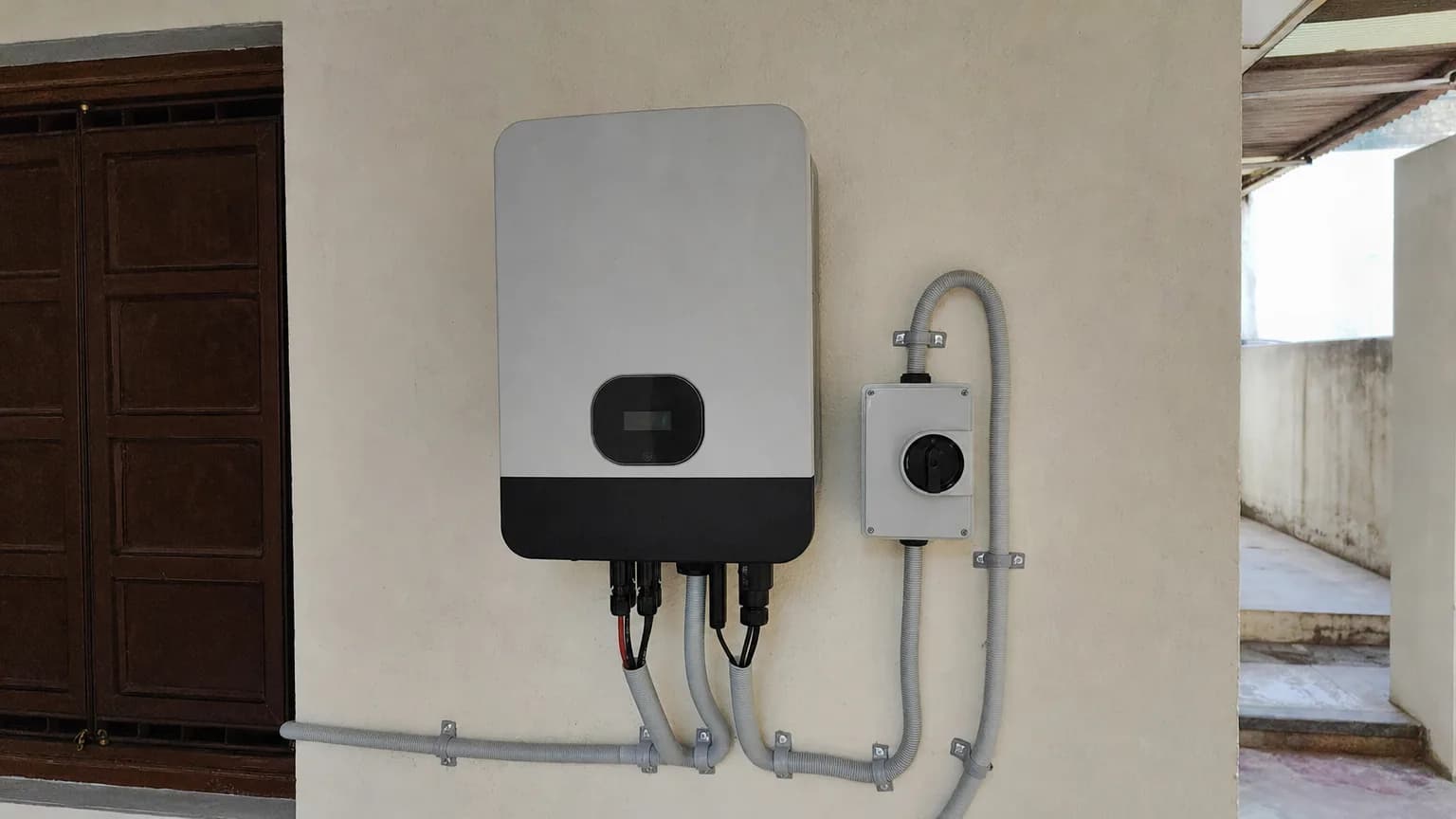
For a home rooftop solar system under PM Surya Ghar in Uttar Pradesh, the solar inverter size is capped: the inverter's AC rating must not be more than your sanctioned load. The simplest match is an inverter rated the same as the system you apply for: 3 kW for a 3 kW system, 5 kW for a 5 kW system. Your panels can add up to a little more, up to 10% above the capacity you applied for under an MNRE advisory of March 2026, so 3.24 kWp of panels on a 3 kW inverter is within the rules. In a PVGIS model of Lucknow weather, a panel-to-inverter ratio that small almost never pushed output up to the inverter's limit, so almost no energy was lost to "clipping". The subsidy is worked out on the panels' capacity, not the inverter's.
Solar inverter size: the short answer by system size
System you apply for | Sanctioned load you need | Inverter AC rating that matches | Panel capacity allowed (DC) | Example with 540 Wp panels |
|---|---|---|---|---|
3 kW | At least 3 kW | 3 kW | Up to 3.3 kWp | 6 panels = 3.24 kWp |
4 kW | At least 4 kW | 4 kW | Up to 4.4 kWp | 8 panels = 4.32 kWp |
5 kW | At least 5 kW | 5 kW | Up to 5.5 kWp | 9 panels = 4.86 kWp, or 10 panels = 5.4 kWp |
The 5 kW example is MNRE's own. The rest of this article explains each rule and where it comes from.
Representative image
Three numbers to know
Sanctioned load (also called contracted load) is the maximum load, in kW, that your DISCOM has agreed to supply under your connection agreement. UPERC's rooftop solar regulations define it this way.
Inverter AC rating is the most power, in kW, that the inverter can send to your home and the grid. The inverter turns the panels' direct current (DC) into the alternating current (AC) your home uses.
Panel capacity is the total rated power of the panels, in kWp ("kilowatt peak"). Six 540-watt panels make 3.24 kWp.
The DC/AC ratio is panel capacity divided by the inverter's AC rating. For 3.24 kWp on a 3 kW inverter, it is 3.24 ÷ 3 = 1.08.
Rule 1: your sanctioned load caps the system
UPERC's Rooftop Solar PV Grid Interactive System Gross/Net Metering Regulations, 2019, regulation 5, say:
The capacity of a grid-connected rooftop system must not exceed 100% of the consumer's connected or contracted demand.
It must be at least 1 kWp and not more than 2 MWp.
It must also fit the connected load or contracted demand rules of the UP Electricity Supply Code, 2005.
MNRE's February 2026 summary of state rooftop solar rules lists the same 100% limit for net metering in UP.
So if your sanctioned load is 3 kW and you want a 5 kW system, your sanctioned load has to be raised to at least 5 kW first.
Rule 2: the inverter stays within your sanctioned load, the panels get 10% leeway
Panels come in fixed sizes, so they rarely add up to exactly 3 kW or 5 kW. MNRE's advisory of 25 March 2026 says vendors complained that some DISCOMs were sending back net-metering applications over small differences, for example 3.24 kW of panels with a 3.0 kW inverter.
MNRE's answer to DISCOMs:
A tolerance of up to 10% may be allowed on the system capacity you applied for, measured on the panels (DC).
The inverter's AC capacity must not exceed your sanctioned load, or the inverter capacity allowed under the regulations.
MNRE's example: for a 5 kW system with 540 Wp panels, you can fit 9 panels (4.86 kWp) or 10 panels (5.4 kWp). Both are within the 10% tolerance, but the inverter is limited to 5 kW.
This is advice from MNRE to DISCOMs, not a UPERC regulation. If your application is sent back over a small panel-to-inverter difference, ask your vendor to point the DISCOM to this advisory. It is posted under What's New on the PM Surya Ghar portal.
Rule 3: the subsidy follows the panels, not the inverter
MNRE's guidelines for the scheme say the subsidy does not depend on the inverter's size. If the inverter is rated higher or lower than the panels, the subsidy is worked out on the panels' rated DC capacity. The inverter must still meet the scheme's technical specifications.
For a 3 to 5 kW home in UP, the subsidy is already at its cap:
Central: Rs 30,000 per kW for the first 2 kW and Rs 18,000 for the third kW, so Rs 78,000 at 3 kW. MNRE's own example: a 6 kW system also gets Rs 78,000.
UP state: Rs 15,000 per kW, up to Rs 30,000.
So the extra 0.24 kWp in a 3.24 kWp system does not add subsidy, and neither does a bigger inverter. Our subsidy calculator works out both subsidies for any size.
What DC/AC ratio and clipping mean
These are general principles of how solar systems work, not rules of the scheme.
Panels rarely make their full rated power. A panel's kWp rating is measured under standard test conditions: sunlight of 1,000 watts per square metre on the panel and a cell temperature of 25 °C. On a UP roof, panels usually run hotter than 25 °C, and they lose power as they heat up. MNRE's specification for the scheme allows a loss of no more than 0.4% of power for each degree of temperature rise. Cables, dust and the inverter itself take a further share. So a little more panel capacity than inverter capacity rarely pushes the inverter to its limit, as the model below shows.
Clipping happens when the panels could deliver more power than the inverter's AC rating. The inverter holds its output at its rating, and the extra is not used. Clipping only matters in the hours when it happens, and how often that is depends on the ratio, the weather and how the panels face.
A worked estimate for Lucknow
To see how often a 3 kW inverter would actually limit 3.24 kWp of panels, we ran a model. This is an estimate, not measured data.
Method. We used PVGIS 5.2, a free solar model run by the European Commission's Joint Research Centre, to get hourly output for 16 years (2005 to 2020) for these inputs:
Location: Lucknow, latitude 26.85 N, longitude 80.95 E, weather from the ERA5 dataset that PVGIS uses for this location
Panels: crystalline silicon, free-standing structure, tilted 31 degrees and facing almost due south (the tilt PVGIS picked as best for the site)
Losses: 14% (PVGIS's default for cables, inverter, dirt and similar) and, as a check, a lower 7%
For each hour, we compared the modelled output with the inverter's limit and counted any output above the limit as clipped. PVGIS gives one-hour averages, so short peaks inside an hour do not show up. Real clipping can be a little higher than this model shows.
Results. Averages per year over the 16 modelled years:
Panels on inverter | DC/AC ratio | Hours a year at the limit (14% losses / 7% losses) | Energy clipped a year (14% losses / 7% losses) |
|---|---|---|---|
3.24 kWp on 3 kW | 1.08 | 0 / about 0.1 | 0 / under 0.01 kWh |
3.30 kWp on 3 kW | 1.10 | 0 / about 0.7 | 0 / about 0.02 kWh |
5.4 kWp on 5 kW | 1.08 | 0 / about 0.1 | 0 / under 0.01 kWh |
3.24 kWp on 2.7 kW | 1.20 | about 1.3 / about 64 | about 0.03 kWh / about 4.6 kWh (0.08%) |
3.24 kWp on 2.5 kW | 1.30 | about 61 / about 294 | about 4.1 kWh (0.08%) / about 37 kWh (0.67%) |
In the same model, 3.24 kWp makes about 5,126 kWh a year before clipping (14% losses), against about 4,746 kWh for 3.0 kWp. That is about 380 kWh a year more from the extra 0.24 kWp, an estimate for a south-facing array at the best tilt.
Representative image
What the model shows:
Within MNRE's 10% tolerance, clipping is close to zero in this model. With an inverter rated the same as the capacity you applied for, the DC/AC ratio cannot go above 1.10, and the model found almost no hours at the limit. In this model the ratio, not the system size, sets the result, so 5.4 kWp on 5 kW behaves like 3.24 kWp on 3 kW.
The limit bites in cool, clear months. In the model, the hours at the limit fall between late morning and early afternoon, mostly from October to April. Panels make more power when they are cooler, and summer heat and monsoon cloud keep the peaks lower. The single highest modelled hour was on 9 February 2012, with an air temperature of about 16 °C.
A smaller inverter clips more. The DC/AC ratio only goes above 1.10 if the inverter is rated below the capacity you applied for. The subsidy stays the same either way.
Roofs that face east or west, a flatter tilt, shade or dust all change these numbers. Other UP towns have different weather. Treat the table as a guide to the size of the effect, not a forecast for your roof.
Single phase or three phase
The UP Electricity Supply Code, 2005, clause 3.2, says how DISCOMs supply new connections and added load:
Contracted load under 5 kW: single phase at 230 V.
5 kW and up to 50 kW: three phase, 4 wire, at 400 V.
The DISCOM can supply a different voltage or phase if its network needs it (clause 3.3).
MNRE's technical specifications for the scheme say that if you have a three-phase connection, the vendor should provide a single-phase or three-phase inverter as you need and as the state's rules allow. Ask your vendor which inverter type your DISCOM accepts for your connection, and get it written on the quote.
Solar inverter or home backup inverter?
An "inverter size calculator" can mean two different jobs:
An on-grid solar inverter is sized to the panels and your sanctioned load, as above.
MNRE's specifications require grid-connected inverters to switch off when the grid fails, so that they do not feed power into lines that workers expect to be dead. A standard on-grid system does not run your home during a power cut.
A backup or hybrid setup with batteries is sized to the appliances you want to run during a cut. MNRE's guidelines allow battery storage as part of a PM Surya Ghar system, but the subsidy is still worked out on the panels' capacity.
What MNRE requires of the inverter itself
MNRE's technical specifications for PM Surya Ghar (Annexure 3 of the guidelines) set the minimum for the inverter. The main points:
It must comply with the Quality Control Order of 30 August 2017 for solar inverters.
It must meet the listed standards, including IS 16221 or IEC 62109 (safety), IS/IEC 61683 (how efficiency is measured), IEC 62116 or IS 16169 (switching off when the grid fails) and IEC 60068-2 (environmental tests).
It must have a built-in MPPT (maximum power point tracker), which keeps the panels working at their best voltage and current as the light changes.
Efficiency of more than 90% for inverters of 10 kW or below with built-in galvanic isolation, power factor above 0.9, harmonic distortion below 3%, and DC injected into the grid of no more than 0.5% of rated output.
Enclosure protection of at least IP65 outdoors or IP54 indoors.
A built-in way to send system data through a SIM or dongle.
An MNRE office memorandum of 17 August 2026 adds that inverter makers must keep monitoring data on servers in India and confirm this in writing to REC within 30 days. A maker that does not confirm is not allowed to install its inverters under the scheme. Ask your vendor to confirm that the inverter model on your quote meets these conditions.
Checklist before you sign
Find your sanctioned load in your connection papers, or ask your DISCOM.
Apply for a system no bigger than your sanctioned load.
Check that the inverter's AC rating on the quote is no more than your sanctioned load. Ask for the model number and datasheet.
Add up the panels: number of panels x watts each. The total should be within 10% of the capacity you applied for.
Check that the inverter suits your connection: single phase or three phase.
Remember that the subsidy depends on the panel capacity and the DCR rules, not on the inverter.
Get your sizing checked
If you want a second look at the numbers for your home, send a photo of your roof and your latest electricity bill on WhatsApp to +91 92609 40733. We will arrange a site survey and check your sanctioned load and supply phase before suggesting panel and inverter sizes.
Related guides:
Sources
- MNRE, Advisory to DISCOMs on sanctioned load and allowed inverter AC capacity for net metering under PM Surya Ghar, F. No. 318/85/2025-GCRT, 25 March 2026, under What's Newpmsuryaghar.gov.in · Accessed 21 November 2026
- MNRE, Operational Guidelines for PM Surya Ghar, CFA to Residential Consumers (7 June 2024, amended to 31 August 2026): sections 5(h) and 5(k) to 5(m); Annexure 3, clauses 1.6 and 2.1 to 2.11 and the standards listpmsuryaghar.gov.in · Accessed 21 November 2026
- Ministry of New and Renewable Energy, Office Memorandum on inverter-level generation data and storage of inverter-level data, 17 August 2026, under What's Newpmsuryaghar.gov.in · Accessed 21 November 2026
- Ministry of New and Renewable Energy, "Rooftop Solar Regulations of States/UTs as on February 2026" (listed as "RTS regulations of States"), Uttar Pradesh row, under What's Newpmsuryaghar.gov.in · Accessed 21 November 2026
- Uttar Pradesh Electricity Regulatory Commission, UPERC (Rooftop Solar PV Grid Interactive System Gross/Net Metering) Regulations, 2019, regulations 2 and 5, with the First (2022), Second (2023) and Third (2025) Amendments, listed under Regulationsuperc.org · Accessed 21 November 2026
- Uttar Pradesh Electricity Regulatory Commission, U.P. Electricity Supply Code, 2005 (consolidated up to the 3rd Amendment), clauses 3.2 and 3.3, with later amendments, listed under Supply Codeuperc.org · Accessed 21 November 2026
- European Commission Joint Research Centre, PVGIS 5.2 hourly radiation and PV output tool (seriescalc), Lucknow, 2005 to 2020re.jrc.ec.europa.eu · Accessed 21 November 2026
- European Commission Joint Research Centre, PVGIS user manual (peak power at standard test conditions, system losses)joint-research-centre.ec.europa.eu · Accessed 21 November 2026
Related guides

BL Solar Solutions
Editorial Team
Published by BL Solar Solutions, a UPNEDA registered rooftop solar installer with 10+ years of experience in Uttar Pradesh.
Comments (0)
Share your thoughts and join the conversation
No comments yet
Be the first to share your thoughts!