3 kW rooftop solar in UP in 2026: official cost range, subsidy and an estimate of what you pay
By BL Solar Solutions · Reviewed by Aditya KumarUpdated · 11 sources
In this article (5 sections)
Official figures put the cost of a 3 kW home rooftop solar system in Uttar Pradesh at about Rs 1,45,000 to Rs 2,10,000 before subsidy. The low end is MNRE's benchmark cost. The high end is UPNEDA's indicative Rs 70,000 per kW. Under PM Surya Ghar, a 3 kW system in UP can get up to Rs 1,08,000 in subsidy: Rs 78,000 from the central government and Rs 30,000 from the state. That leaves an estimated Rs 37,000 to Rs 1,02,000 for you to pay. This is an estimate based on official figures, not a quote. Real quotes can fall outside this range. You pay the full price first, and the subsidy comes back after the DISCOM inspects the system and you redeem it on the portal.
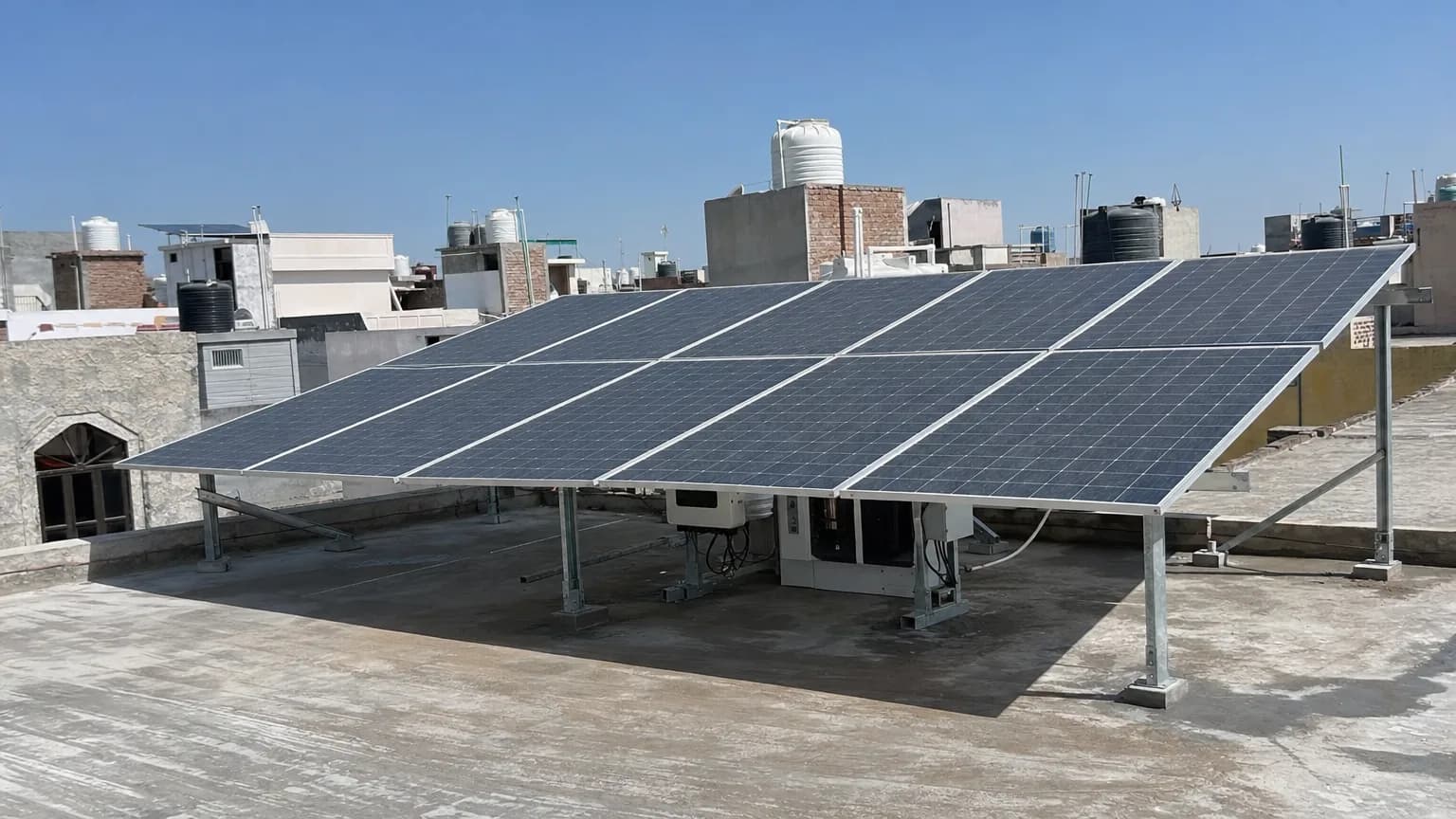
Official rooftop solar cost range and subsidy for 1, 2 and 3 kW
System size | Official cost range (MNRE benchmark to UPNEDA's Rs 70,000/kW) | Central subsidy | UP subsidy | Total subsidy | Left to pay (estimate) |
|---|---|---|---|---|---|
1 kW | Rs 50,000 to Rs 70,000 | Rs 30,000 | Rs 15,000 | Rs 45,000 | Rs 5,000 to Rs 25,000 |
2 kW | Rs 1,00,000 to Rs 1,40,000 | Rs 60,000 | Rs 30,000 | Rs 90,000 | Rs 10,000 to Rs 50,000 |
3 kW | Rs 1,45,000 to Rs 2,10,000 | Rs 78,000 | Rs 30,000 | Rs 1,08,000 | Rs 37,000 to Rs 1,02,000 |
Above 3 kW, both subsidies stay at their cap: Rs 78,000 central and Rs 30,000 state.
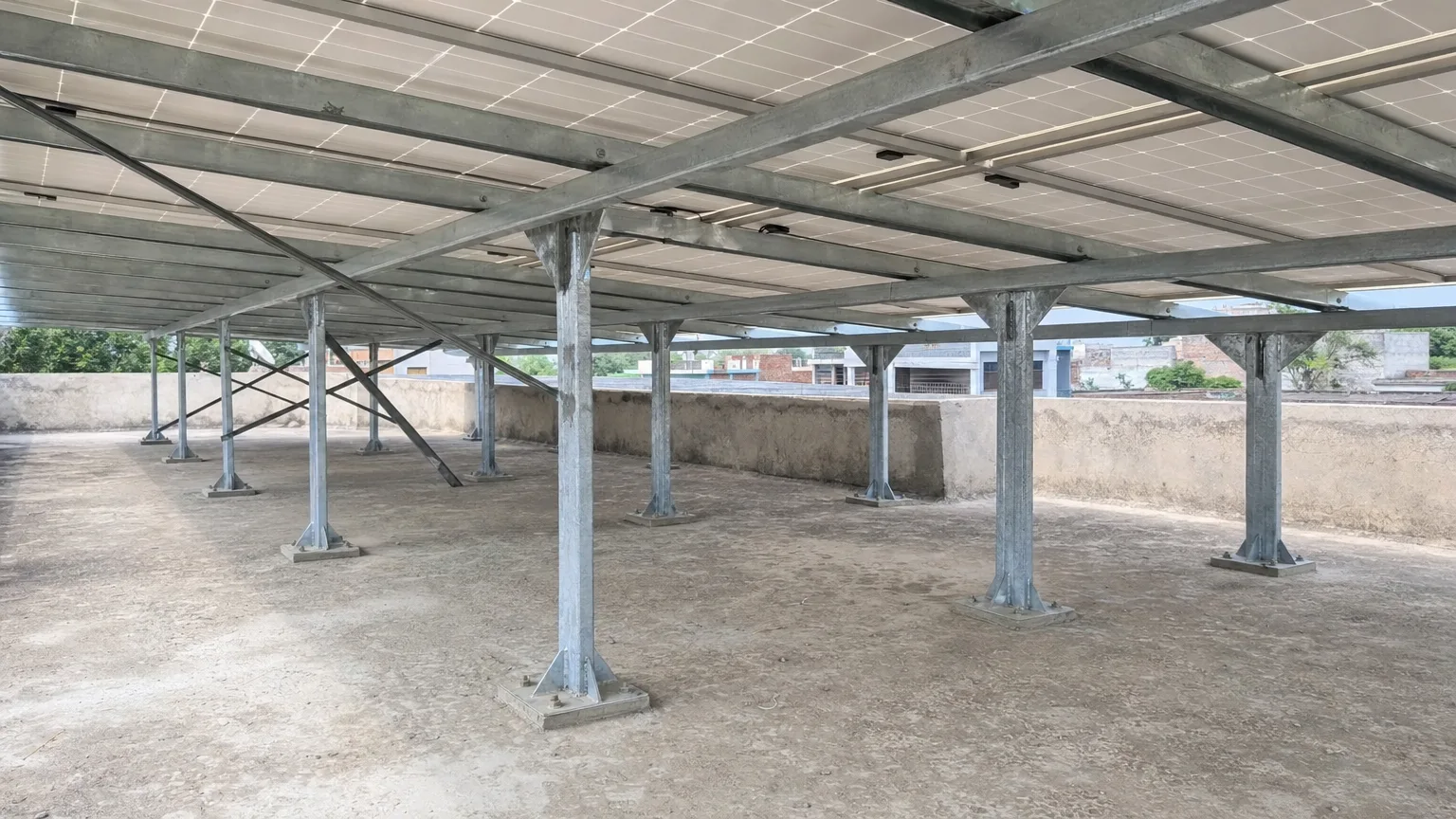
Illustration (AI-generated, not a BL Solar installation): a raised mounting structure, one of the items that changes a quote. The cost range and subsidy figures are in the table above.
How the numbers are worked out
Low end: MNRE's benchmark cost. MNRE fixed it at Rs 50,000 per kW for the first 2 kW and Rs 45,000 for the additional kW, from 13 February 2024. MNRE uses it to set the subsidy. The guidelines do not say whether it includes GST. They say it will be revised at the scheme's mid-term review if market prices change. The amended guidelines published in August 2026 still show these figures.
High end: UPNEDA's indicative cost. UPNEDA's rooftop solar FAQ says the average cost depends on the vendor and the quality of components, and "will vary between 60 to 70 thousand per kWp". The range above uses the top of that figure, Rs 70,000 per kW. The FAQ has no date and does not say whether GST is included.
Central subsidy. It is 60% of the benchmark for the first 2 kW and 40% for the third kW. That works out to Rs 30,000 per kW for the first 2 kW and Rs 18,000 for the third kW, with nothing more above 3 kW. It is worked out pro rata on the panels' (DC) capacity, not the inverter's. MNRE's own example: a 2.5 kW system gets Rs 30,000 x 2 + Rs 18,000 x 0.5 = Rs 69,000.
UP subsidy. The UP Solar Energy Policy 2022 gives Rs 15,000 per kW, up to Rs 30,000 per consumer, after the system is installed and commissioned with net metering. UPNEDA releases it after the central subsidy has been paid.
Three things to know:
You pay first. The scheme works on a "capex" basis, which means you pay for the system, from savings or a loan, and the subsidy comes back later.
The benchmark is not a price list. MNRE's guidelines say you and a vendor registered on the portal agree the price between yourselves. DISCOMs and state agencies do not run tenders or set rates for vendors under the scheme.
The scheme has an end date. The national portal says the scheme closes on 31 March 2027.
What can change your quote
Panel type
DCR panels. To get the subsidy, your panels must meet the Domestic Content Requirement (DCR): made in India, from cells made in India. MNRE's guidelines say that using non-DCR panels anywhere in the system makes it ineligible for the central subsidy. The portal checks DCR panels against a verification system run by the National Institute of Solar Energy.
Non-DCR panels. Under an MNRE office memorandum of 30 March 2026, you can install non-DCR panels through the portal only if you choose "Give It Up", that is, you give up the subsidy. Once you confirm the installation with non-DCR panels, you cannot switch back.
From 1 June 2026, under MNRE's ALMM rules as quoted in its advisory of 21 May 2026, net-metering projects commissioned on or after that date must use modules from ALMM List-I and cells from ALMM List-II. ALMM is MNRE's approved list of models and manufacturers. An MNRE office memorandum of 8 June 2026 makes one exception: a home that chooses "Give It Up" and applies through the national portal does not need List-II cells until 31 March 2027.
Structure height
The mounting structure holds the panels above the roof. A raised structure lets you use the roof space under the panels.
MNRE's technical specifications for the scheme group raised structures on RCC roofs by their clearance from the roof, and ask for stronger parts as the height grows. The guidelines mark these figures "for reference only":
Clearance from roof | Minimum base plate thickness |
|---|---|
Up to 1,000 mm (about 3.3 ft) | 5 mm |
1,000 to 2,000 mm (about 3.3 to 6.6 ft) | 6 mm |
2,000 to 3,000 mm (about 6.6 to 9.8 ft) | 8 mm |
More than 3,000 mm | Separate category, with a 10 mm base plate |
The columns, rafters and bracing also get heavier at each step, so expect the structure line on your quote to change with the height you choose. Structures can be made of hot-dip galvanised iron, aluminium, hot-dip galvanised mild steel, or, since May 2026, zinc-aluminium-magnesium (ZAM) alloy. MNRE prefers mild steel for raised structures.
Two more rules:
If the panels are not on a roof but on a separate elevated structure, it needs at least 8 feet of ground clearance at its lowest point to qualify for the subsidy.
The UP Solar Energy Policy 2022 says rooftop solar structures up to 4.5 metres high are not counted in the building's height under the building byelaws.
Why your "3 kW" quote may say 3.24 kW
Panels come in fixed sizes, so they rarely add up to exactly 3 kW. In March 2026, MNRE advised DISCOMs to accept panel capacity up to 10% above the applied capacity, as long as the inverter's AC capacity does not exceed your sanctioned load. Six 540-watt panels, for example, make 3.24 kW. The extra 0.24 kW does not raise your subsidy, because both subsidies are already at their cap at 3 kW.
What a 3 kW quote should include
MNRE's guidelines list what a rooftop system under the scheme consists of:
Solar panels
Inverter
Mounting structure
Net meter or smart meter
Array junction box, DC distribution box and AC distribution box
Earthing, lightning and surge protection
Cables
Drawings and manuals
MNRE's model vendor-consumer agreement also covers design, supply, installation, commissioning and 5 years of comprehensive maintenance, and a 5-year warranty on the complete system from the date the DISCOM commissions it. Your actual agreement can differ, so check each of these lines on the quote. Ask for GST to be shown separately.
Since September 2026, the vendor must enter the total cost of the installation, including taxes and all charges, when uploading your agreement on the portal. You then approve or reject it in your own login. Check that this figure matches your quote.
Who pays for the net meter. MNRE's guidelines say the net meter is provided by the DISCOM, or you may buy one from listed meter vendors. MNRE's model vendor agreement puts net meter supply, testing and approvals in the vendor's scope. Its model net metering agreement says the consumer bears the cost of net meters. In areas where smart metering was awarded under RDSS, the net meter should be a smart meter installed through the AMISP, the agency that runs the smart meters. UPPCL's FAQ says current smart meters can handle net metering, so if you already have one, it does not need to be changed. Ask your vendor to write on the quote who supplies the meter and whether its cost is included.
Network work. If the DISCOM says the line or transformer needs strengthening for your system, the central Electricity (Rights of Consumers) Rules, as amended in February 2024, say the DISCOM does this at its own cost for rooftop systems up to 5 kW.
Your out-of-pocket cost
Your real cost is the quoted price minus the subsidy that comes back later:
Quoted price - total subsidy = your net cost
For 3 kW, that is Rs 1,45,000 - Rs 1,08,000 = Rs 37,000 at MNRE's benchmark cost, and Rs 2,10,000 - Rs 1,08,000 = Rs 1,02,000 at UPNEDA's Rs 70,000 per kW. Put your own quote in place of these to get your own figure. For a 2.5 kW system, the subsidy would be Rs 69,000 central plus Rs 30,000 state, Rs 99,000 in all.
Because you pay the full price first, plan for the gap until the subsidy arrives. The national portal links to bank loans through the Jan Samarth portal. MNRE's guidelines expect low-interest loans at around the repo rate plus 0.5% for systems up to 3 kW. In February 2024 the government described these as collateral-free loans at "around 7% at present"; check the current rate with the bank. If you take a loan through the portal, the central subsidy is paid into your loan account. Our solar EMI calculator shows the monthly instalment for any loan amount.
Get a quote for your roof
If you want a written, itemised quote, send a photo of your roof and your latest electricity bill on WhatsApp to +91 92609 40733. We will arrange a site survey and tell you which structure your roof needs.
Related guides:
Sources
- PM Surya Ghar: Muft Bijli Yojana National Portal, home page (subsidy table, closing date, loan-case announcement)pmsuryaghar.gov.in · Accessed 20 November 2026
- MNRE, Operational Guidelines for PM Surya Ghar: Muft Bijli Yojana, component "CFA to Residential Consumers" (7 June 2024, amended 7 July 2025 and 31 August 2026), sections 5(c), 5(e), 5(g), 5(h), 5(j), 5(k), 5(m), 6(c), 6(l), 6(m), 6(r) and 6(s)pmsuryaghar.gov.in · Accessed 20 November 2026
- MNRE, Operational Guidelines for PM Surya Ghar, component "CFA to Residential Consumers": Annexure 2 (model vendor agreement), Annexure 3 (technical specifications) and Annexure 4 (model net metering agreement)pmsuryaghar.gov.in · Accessed 20 November 2026
- MNRE office memoranda of 30 March 2026 (Give It Up without DCR), 19 May 2026 (structure materials) and 8 June 2026 (ALMM List-II and Give It Up), under What's Newpmsuryaghar.gov.in · Accessed 20 November 2026
- MNRE advisories of 25 March 2026 (capacity tolerance) and 21 May 2026 (ALMM List-II), and portal notice "Consumer Verification of Agreement Upload" (23 September 2026), under What's Newpmsuryaghar.gov.in · Accessed 20 November 2026
- Prime Minister's Office, "Cabinet approves PM-Surya Ghar: Muft Bijli Yojana", 29 February 2024pmindia.gov.in · Accessed 20 November 2026
- Press Information Bureau, "Electricity (Rights of Consumers) Amendment Rules, 2024", 23 February 2024pib.gov.in · Accessed 20 November 2026
- Uttar Pradesh Power Corporation Ltd, "Smart Post-paid Meter FAQ" (Hindi), dated 27 May 2026, question 32smartapplink.uppcl.org · Accessed 20 November 2026
- Government of Uttar Pradesh, Uttar Pradesh Solar Energy Policy 2022 (hosted by UPNEDA)upneda.org.in · Accessed 20 November 2026
- UPNEDA, "How to Avail State Subsidy"upneda.org.in · Accessed 20 November 2026
- UPNEDA, "FAQs related to rooftop solar", question 2.1 (average cost per kWp)upneda.org.in · Accessed 20 November 2026
Related guides

BL Solar Solutions
Editorial Team
Published by BL Solar Solutions, a UPNEDA registered rooftop solar installer with 10+ years of experience in Uttar Pradesh.
Comments (0)
Share your thoughts and join the conversation
No comments yet
Be the first to share your thoughts!